Understanding LFP Grinding Requirements in Battery Manufacturing
Lithium iron phosphate (LFP) cathode active materials require precision milling to achieve target electrochemical performance. We have extensive experience in the crushing and processing of lithium battery materials, where raw calcined agglomerates must be transformed into engineered powders that support fast ion transport, high tap density, and uniform electrode coating.

The Critical Role of Particle Size and Distribution
Due to the inherently low electrical conductivity and slow lithium-ion diffusion rate of pristine LFP, particle size reduction is fundamental to cell efficiency. Achieving a precise, narrow particle size distribution directly controls rate capability and energy density.
- Target Median Diameter (D50): Typically controlled between 1.0 to 2.5 µm to shorten lithium diffusion pathways.
- Top-Cut Control (D90 / D99): Strict elimination of coarse particles above 5 to 7 µm to ensure uniform slurry rheology and prevent electrode coating defects.
- Fines Limitation (D10): Restricting ultra-fine fractions below 0.3 µm to reduce specific surface area (BET) surge and optimize binder consumption.
| Parameter Metric | Target Specification | Impact on Battery Cell Performance |
|---|---|---|
| D50 (Median Size) | 1.0 – 2.2 µm | Optimizes high-rate discharge and ionic conductivity |
| Dmax / Top-Cut | < 5.0 – 8.0 µm | Eliminates separator puncture risks and coating streaks |
| Span [(D90-D10)/D50] | < 1.2 – 1.5 | Maximizes electrode packing density and volumetric energy |
| Specific Surface Area | 9.0 – 14.0 m²/g | Stabilizes slurry viscosity and preserves binder efficacy |
Purity Standards and Contamination Prevention
Battery-grade LFP production enforces zero-tolerance standards for foreign metal contamination. Even parts-per-billion (ppb) inclusions of free metals can trigger severe battery failure mechanisms.
- Magnetic Contaminant Risks: Free iron (Fe), copper (Cu), zinc (Zn), and chromium (Cr) particles cause internal micro-shorts and accelerate self-discharge.
- Material Contact Zones: Grinding systems require dedicated non-metallic protection, including tungsten carbide, silicon carbide, or high-purity alumina ceramics.
- Purity Verification: Cathode processing must maintain total foreign metallic impurities under stringent quality thresholds, often requiring post-grinding magnetic separation stages.
Heat Sensitivity and Deagglomeration Challenges
Modern commercial LFP undergoes sintering with carbon sources to form a thin, conductive carbon layer on each primary particle. Milling must deagglomerate calcined clusters without destroying this functional architecture.
- Carbon Coating Integrity: Excessive mechanical shear can peel or disrupt the nanometer-scale carbon coating, degrading overall electrical conductivity.
- Thermal Management: Localized high temperatures during grinding can induce phase instability or secondary particle sintering.
- Targeted Deagglomeration: The equipment must selectively break secondary sintered necks while preserving primary crystallite integrity.
Working Principles: Jet Mill vs. Impact Mill
We have extensive experience in the crushing and processing of lithium battery materials, and understanding how these systems operate is the first step in optimizing your cathode production. While both systems pulverize feedstocks down to the micron scale, they rely on entirely different physical mechanisms to achieve the target particle size distribution for lithium iron phosphate.
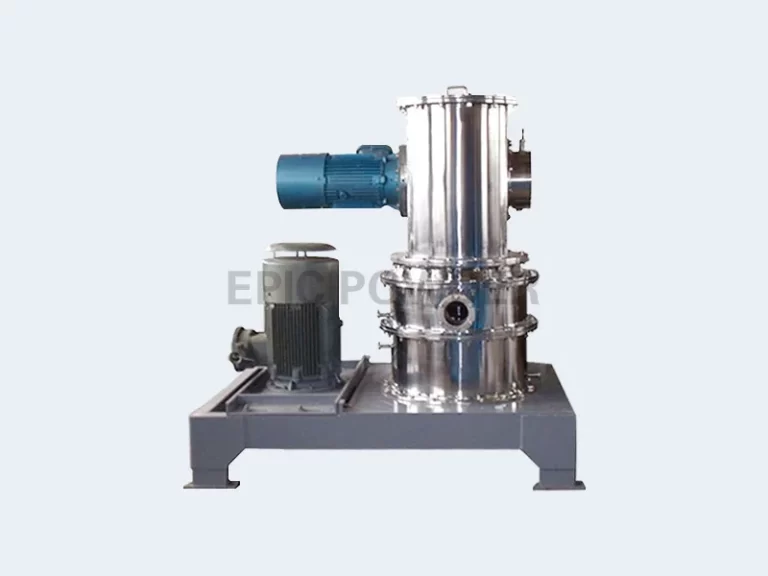
How Jet Mills Work (Fluid Energy and Particle Collisions)
A fluidized bed jet mill relies purely on fluid dynamics rather than mechanical contact to break down material.
- High-Velocity Gas Expansion: Compressed dry air or inert gas (typically nitrogen) is injected into the grinding chamber through specially aligned supersonic nozzles.
- Particle-on-Particle Impact: The gas streams create a localized fluidized bed where raw LFP agglomerates accelerate toward the center. The particles violently collide with each other, causing autogenous pulverization.
- Dynamic Classification: The expanding gas carries the pulverized powder upward toward an integrated dynamic classifier wheel. Fine particles that meet the specification pass through to the cyclone collector, while oversized particles are rejected and fall back into the grinding zone.
Because the grinding action occurs purely between the particles themselves, using special jet milling equipment for battery materials virtually eliminates media wear and keeps foreign metal contamination to an absolute minimum. Understanding the balance between nozzle pressure and wheel speed is key to master how to control the particle size of lithium iron phosphate pulverized by air jet mill systems reliably.
How Impact Mills Work (Mechanical Impact and Air Classification)
A mechanical air classifier mill utilizes direct mechanical energy and managed airflow to achieve rapid size reduction.
- High-Speed Mechanical Impact: Raw lithium iron phosphate enters the grinding chamber and directly contacts a high-speed rotating rotor equipped with impact pins, hammers, or beaters.
- Shear and Attrition: The material is pulverized both by direct impact with the spinning elements and by collision against the surrounding stationary stator liner.
- Continuous Air Sorting: Process air sweeps through the mill continuously, cooling the chamber and transporting pulverized particles directly to an internal horizontal or vertical classifier wheel.
The air classifier mill combines grinding and classifying in a single compact housing. Particles ground to the correct cut point immediately exit the mill, preventing over-grinding, while coarse fractions are directed back into the rotor path for immediate re-crushing. This direct mechanical drive delivers high energy transfer directly to the material bed, maximizing processing efficiency.
Jet Milling for LFP: Key Advantages and Limitations
We have extensive experience in the crushing and processing of lithium battery materials, and we know firsthand that jet milling remains a cornerstone technology for processing lithium iron phosphate cathodes. When strict particle standards dictate battery performance, this technology delivers distinct technical strengths along with specific operational trade-offs.
Ultrafine Grinding with Narrow Particle Size Distribution
A fluidized bed jet mill relies on high-velocity gas streams to make particles collide with each other, rather than grinding them against mechanical parts. This mechanism delivers exceptional control over the finished powder:
- Precise Top-Cut Control: Integrated dynamic classifiers ensure strict D97 cut-offs, preventing oversize particles that disrupt downstream electrode coating.
- Narrow Particle Size Distribution: The system creates a sharp distribution curve, eliminating fines while hitting the targeted D50 micron range.
- Preserved Crystal Structure: Autogenous grinding preserves the material morphology, which directly supports higher tap density and efficient electrochemical reactions.
Understanding how to achieve ultrafine grinding of LFP battery materials starts with maintaining this balance between velocity, classification speed, and particle interaction.
Contamination-Free Grinding for High-Purity Cathodes
Cathode purity directly governs cell lifespan and safety. Any foreign metal trace, especially magnetic iron, can cause catastrophic micro-short circuits in lithium iron phosphate cells.
- Zero Tool Wear: Because LFP particles grind against themselves inside the chamber, no grinding media or mechanical blades wear down into the powder.
- Ceramic Linings: Critical contact zones use solid structural ceramics, such as aluminum oxide or silicon carbide, keeping magnetic contamination below single-digit parts per billion.
- Consistent Batch Purity: Without metallic wear components to degrade over time, every run retains consistent purity and clean chemical composition.
High Energy Consumption and Throughput Trade-offs
While jet milling leads in quality, it demands careful management of energy and operating costs:
- High Compressed Air Demand: Supplying high-pressure air or inert gas requires significant compressor power, making the process energy-intensive per ton of finished product.
- Throughput Limitations: Compared to high-speed mechanical mills, jet systems yield lower hourly output on large bulk volumes.
- Operating Cost Trade-off: The high utility demand means jet milling is best utilized when strict top-cut and zero contamination take priority over sheer production volume.
Impact Milling for LFP: Key Advantages and Limitations
We have extensive experience in the crushing and processing of lithium battery materials, and mechanical impact systems remain an essential workhorse in commercial production lines. Utilizing high-speed rotors and integrated classification, an air classifier mill delivers continuous, high-volume processing for lithium iron phosphate, though mechanical contact introduces clear engineering trade-offs.
High Production Capacity and Throughput
Mechanical impact milling provides substantial throughput advantages for large-scale operations. When balancing the advantages and disadvantages of ternary lithium-ion batteries and lithium iron phosphate batteries, cost and manufacturing volume often drive LFP selection, making high-capacity machinery vital.
- Massive Output: Handles continuous bulk feed rates with minimal dwell time inside the grinding chamber.
- Inline Scalability: Seamlessly integrates with upstream calcination and downstream coating systems.
- Controlled Classification: Integrated dynamic classifier wheels help govern the primary particle size distribution without halting production flow.
Lower Energy Consumption and Operational Costs
Direct drive mechanical power makes impact milling inherently more energy-efficient than pneumatic systems that require large industrial air compressors.
- Reduced Power Draw: Consumes significantly fewer kilowatt-hours per ton of processed material.
- Lean Ancillary Footprint: Eliminates the need for high-pressure air generation, drying, and complex multi-stage filtration units.
- Lower OPEX: Direct mechanical transfer lowers ongoing utility bills, maintaining cost efficiency across continuous shifts.
Wear Parts and Risk of Metal Contamination
The primary limitation of mechanical milling lies in physical surface contact. Because grinding occurs via direct contact with high-speed pins, hammers, or track plates, mechanical stress affects both the equipment and the cathode purity.
- Foreign Metal Pickup: High-velocity impact creates abrasive friction. Any microscopic metallic wear risks introducing tramp iron or alloy debris into the cathode mix, compromising cell safety.
- Protective Linings Required: Critical wear zones require protective ceramic components, such as zirconia, tungsten carbide, or silicon carbide linings, to isolate the product path.
- Scheduled Maintenance Cycles: Rotors, grinding tracks, and classifier wheels undergo inevitable physical degradation, necessitating routine inspection, component balancing, and periodic replacements.
Head-to-Head Comparison: Jet Mill vs. Impact Mill for LFP
Choosing the right equipment to crush lithium iron phosphate comes down to how both systems perform under real factory conditions. We have extensive experience in the crushing and processing of lithium battery materials, and evaluating these units side by side reveals distinct strengths for different stages of cathode manufacturing.
| Performance Metric | Fluidized Bed Jet Mill | Air Classifier Impact Mill |
|---|---|---|
| Top-Cut Precision (D97/D100) | Extremely sharp top-cut, sub-micron capable | Good top-cut, minor risk of oversize bypass |
| Particle Size Distribution (Span) | Very narrow span | Moderate to narrow span |
| Iron Contamination Risk | Near zero (ceramic-lined, self-collision) | Moderate to low (requires high-wear liners) |
| Operating Temperature | Low (cooling via gas expansion) | Moderate to high (mechanical friction) |
| Energy Consumption (OPEX) | Higher (driven by compressed gas) | Significantly lower direct power usage |
| Initial Capital Cost (CAPEX) | Higher total footprint and compressor investment | Lower machine and auxiliary setup costs |
Particle Size Control and Top-Cut Precision
Cathode slurry coating requires a strict particle size distribution without large oversize grains or excessive superfines.
- Fluidized bed jet mill: High-velocity gas streams force LFP particles to collide only with each other. Integrated high-efficiency dynamic classifiers reject oversize grains back into the grinding zone continuously, yielding a steep distribution curve and a clean, predictable D97. If you want to know to what extent can the jet mill used in the battery material industry be crushed, modern systems comfortably handle micron and sub-micron target cuts without tailing.
- Mechanical impact mill: A rotating hammer or pin disc drives particles into liner tracks, paired with an internal classifier wheel. While efficient, mechanical clearances allow a small fraction of coarse particles to bypass the wheel under surging feed conditions, resulting in a slightly wider span.
Product Purity and Wear Resistance
Iron contamination ruins battery safety and causes severe self-discharge in cells. Cathode processors must protect every contact point inside the grinding chamber.
- Jet milling: Grinding occurs inside the gas cloud rather than against mechanical tools. To secure zero metallic pick-up, we configure systems with fully non-metallic linings. Using a full ceramic jet mill for battery materials made of silicon carbide or zirconia prevents foreign metallic impurities from entering high-grade lithium iron phosphate.
- Impact milling: High-speed mechanical rotors strike the raw material directly. Even with tungsten carbide, ceramic tiles, or polyurethane coatings, abrasive LFP feed causes gradual mechanical wear over thousands of operating hours, requiring routine magnetic separation downstream.
Thermal Management and Heat Control
LFP can degrade or agglomerate if processing temperatures climb unchecked during fine milling.
- Jet mills provide natural cooling: The expansion of compressed air through supersonic nozzles creates a Joule-Thomson cooling effect inside the grinding chamber. The internal temperature remains stable or drops slightly, protecting pre-treated carbon coatings on the LFP particles.
- Impact mills generate frictional heat: High-speed mechanical rotation transfers mechanical energy into heat. Running an air classifier mill on LFP requires high-volume process air, chilled air handling, or water-jacketed housings to keep operating temperatures below critical thresholds.
Capital Investment vs. Operating Expenses
Balancing plant economics requires weighing upfront equipment costs against ongoing energy bills:
- Jet mill balance: Lower mechanical maintenance because there are no fast-spinning drive shafts in the grinding zone. However, running large industrial air compressors increases daily electrical utility costs.
- Impact mill balance: Delivers substantially higher kilogram-per-kilowatt output. The initial capital layout for the mill and blowers is lower, though maintenance budgets must account for scheduled rotor, pin, and wear liner replacements.
Which is Better for LFP Grinding? How to Choose
We have extensive experience in the crushing and processing of lithium battery materials, and selecting the right system comes down to your production priorities: strict purity versus energy efficiency. Neither machine is universally “better”; each serves distinct stages and target specifications in lithium iron phosphate cathode production.
| Decision Factor | Fluidized Bed Jet Mill | Air Classifier Mill (Impact Mill) |
|---|---|---|
| Primary Advantage | Zero metal contamination, steep PSD curve | High throughput, lower specific energy use |
| Best Particle Size Range | Ultrafine (D50: 0.8 – 2.0 µm) | Fine to medium (D50: 2.0 – 5.0 µm) |
| Contamination Risk | Extremely low (autogenous particle collision) | Low to moderate (requires ceramic lining) |
| Operating Cost (OPEX) | Higher (compressed gas requirements) | Lower (mechanical motor drive) |
| Capital Cost (CAPEX) | Higher initial auxiliary equipment cost | Lower system investment cost |
When to Choose a Jet Mill for LFP Processing
A fluidized bed jet mill is the ideal choice when end-product specifications prioritize tight control over electrical conductivity and electrochemical performance.
- Strict Purity Requirements: Particle collisions occur autogenously in the fluid stream, keeping iron contamination to negligible levels.
- Precise Top-Cut Control: Integrated dynamic classifiers ensure an exceptionally steep particle size distribution with no oversized tails (tight D99 and Dmax control).
- Heat-Sensitive Agglomerates: Expanding compressed gas naturally cools the grinding chamber, protecting carbon coatings and synthetic structures from thermal degradation.
When to Choose an Impact Mill (Air Classifier Mill)
An air classifier mill is the best option when the production target focuses on maximizing volume while controlling capital and utility costs.
- High-Capacity Processing: Delivers high output per hour, handling large-scale continuous runs efficiently.
- Lower Operational Expenses: Uses direct mechanical impact rather than large volumes of compressed air, sharply reducing kilowatt-hour consumption per ton.
- Pre-Crushing and Sintered Cake Breakdown: Highly effective for deagglomerating bulk material after kilning before final surface modifications.
Combined Grinding Configurations in Commercial LFP Production Lines
Modern manufacturing lines rarely rely on a single technology. To balance processing costs with strict cathode specs, standard plant designs combine both systems into an integrated circuit:
- Stage 1 (Coarse Sizing & Deagglomeration): An air classifier mill handles primary particle breakdown directly after calcination, reducing bulk materials to intermediate sizes at low energy consumption.
- Stage 2 (Final Micronization): A fluidized bed jet mill finishes the process, creating uniform ultrafine particles and enforcing tight top-cut limits without metal pickup.
This two-stage methodology is widely implemented across large-scale facilities, such as our lithium iron phosphate ultrafine grinding production line, delivering optimal throughput, energy efficiency, and cathode performance.